[Editor’s Note: This one’s not from me – it’s from BuffsBlog contributor Chris Gaddis, who knows this program as well as ayone. Welcome him in the comments.]
Congress wants to save college sports. Good luck with that.
Ronald Reagan famously called “I’m from the government, and I’m here to help” the nine most terrifying words in the English language. Yet, college sports have devolved into such a chaotic, multi-billion-dollar free-for-all that athletic departments are actually begging Capitol Hill for rescue.
Let that sink in for a minute.
We have somehow managed to take one of America’s greatest inventions, college football, and create a system so completely irrational that the people we are now asking to fix it are the same people who can’t agree on how to fund the government.
And yet, here we are.
This month, the U.S. Senate voted 74–24 to advance the Protect College Sports Act, a bipartisan attempt to bring some semblance of order to the wonderfully entertaining, completely irrational and increasingly expensive world of college athletics.
And before you immediately stop reading because I used the words Congress and Act in the first few paragraphs, stick with me.
Because this one actually matters. It matters to the Big 12. It matters to Colorado. It matters to schools trying to compete in a world where athletes can transfer every year, rosters can essentially be rebuilt through free agency, NIL has morphed into something nobody envisioned five years ago, and athletic departments are spending money at a rate that would make Jerry Jones blush.
Most importantly, it could help determine what college football looks like for the next decade.
And, incredibly, Congress might actually have a point.
Remember When College Football Was Simple?
Neither do I. But it was certainly simpler.
You recruited high school kids. They signed letters of intent. They sat out a year if they transferred. The NCAA pretended everyone was an amateur. We all pretended to believe them.
Then the dam broke. NIL arrived. The transfer portal became free agency. Schools started directly sharing revenue with players. Conferences blew themselves up chasing television money. USC and UCLA joined the Big Ten. The Pac-12 effectively disappeared (sorry Rammies). Colorado went back to the Big 12.
And somewhere along the way, college football became a professional sport operating inside universities without most of the rules that normally accompany professional sports.
It’s wildly entertaining.
It’s also probably unsustainable.
Enter Congress
The Protect College Sports Act is an attempt to establish some national rules.
The legislation would protect athletes’ ability to make money from their name, image and likeness. Good. NIL isn’t going anywhere. It would preserve direct revenue sharing between schools and athletes. Also not going anywhere.
But the more you dig into this thing, the more interesting it gets.
Congress isn’t trying to put NIL back in the bottle. Players are still going to get paid. Schools are still going to share revenue. There will still be a transfer portal.
What Congress is really trying to do is put some boundaries around all of it. One free transfer instead of unlimited free agency. Five years of eligibility instead of seemingly endless lawsuits over sixth and seventh seasons. A $22.5 million athlete-retention fund, with schools able to unlock another $5 million if they also invest that amount in NIL opportunities for women’s and Olympic sports. [Note that this athlete-retention fund is in addition to the $21.6m NIL fund, which means programs can spend nearly $50 million per year paying athletes under the College Sports Act.]
There are rules for agents, including registration requirements and a 5% cap on agent fees. NIL contracts would have disclosure and transparency requirements. Athletes would receive scholarship and healthcare protections, including a 10-year scholarship guarantee and, at Division I schools, five years of post-eligibility medical coverage for sports-related injuries.
Hell, Congress even wants to stop football coaches from bailing on their teams in the middle of the season to start recruiting and building the roster at their next school.
Apparently Congress looked at college football and decided the adults needed transfer restrictions, too.
None of this makes college athletics amateur again.
That ship sailed a long time ago.
What it does is acknowledge something everyone already knows: college sports have become a multibillion-dollar professional enterprise operating inside universities, and if that’s what we’re going to have, maybe having a few actual rules isn’t the worst idea in the world.
Football Can’t Eat Everything
We all know what pays the bills. Football.
At Colorado, nothing moves the needle like football. Folsom is full. Television ratings jump. Merchandise sells. Donors get excited. Boulder becomes the center of the college football universe for a Saturday afternoon.
And now we have a better idea just how expensive competing in this new world has become.
Earlier this month, The Athletic talked to more than 70 coaches, athletic directors, agents and others across college football to estimate what Power Four programs are spending to build their 2026 rosters.
The numbers are staggering.
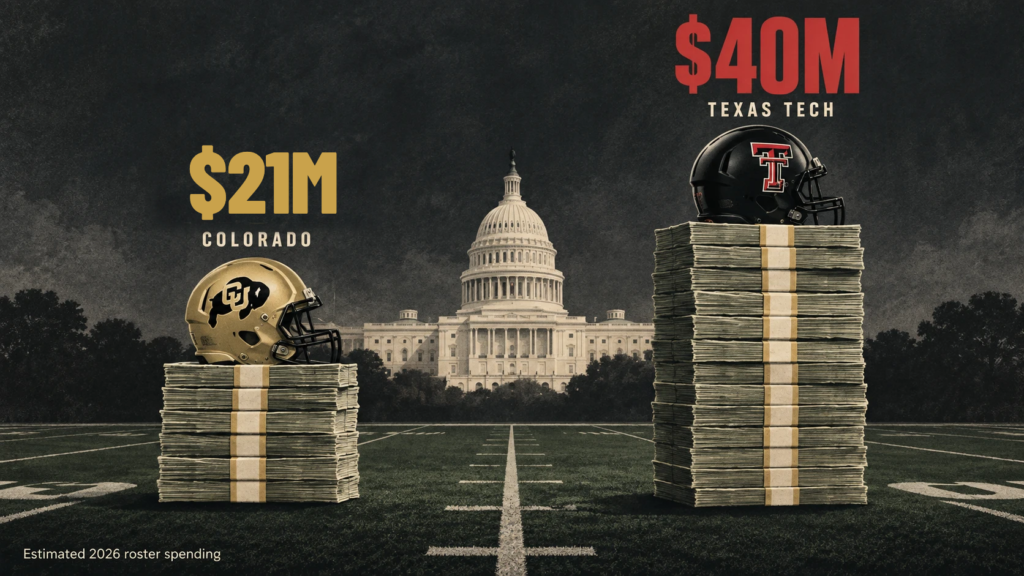
Colorado’s roster is estimated to cost somewhere between $18 million and $21 million. That’s a lot of money. Until you look around.
| Conference | Estimated average 2026 roster budget |
| SEC | $33 million – $38 million |
| Big Ten | $27 million – $31 million |
| ACC | $21 million – $25 million |
| Big 12 | $18 million – $22 million |
And then there’s Texas Tech. The Red Raiders are estimated to be spending $38 million to $42 million on their 2026 roster, roughly twice what Colorado is spending and basically Alabama money. That’s not hyperbole. Alabama’s estimated range is also $38 million to $42 million.
Ohio State is pushing $50 million. Oregon could be north of $50 million. Texas, LSU, Texas A&M and Miami are all playing in that neighborhood.
We aren’t talking about NIL anymore.
We’re talking about payroll. And unlike the NFL, there is no salary cap. No draft. No collectively bargained spending system. No real mechanism preventing Ohio State from spending $50 million while another Power Four school spends $10 million.
The market’s answer is basically: raise more money. Congress has a slightly different idea.
The bill would establish a $22.5 million retention fund for schools to compensate athletes and then allow schools to increase that amount by as much as $5 million, but only dollar-for-dollar with NIL spending on women’s and Olympic sports. That’s actually pretty clever.
Want to spend another $5 million retaining football and basketball players? Fine. Find $5 million for athletes in the other sports, too. The bill goes further, requiring schools to maintain women’s and Olympic-sport roster spots and grants-in-aid at 2024–25 levels.
Colorado has produced Olympic athletes, national champions and extraordinary competitors in sports most of us don’t spend our Saturdays watching. Those programs matter. And here’s the problem with the new college sports economy: there is no obvious stopping point.
If somebody spends $30 million, somebody else spends $35 million. Then $40 million. Then $50 million. And every athletic director in America gets to explain why his football coach needs another few million dollars to remain “competitive.”
Eventually that money has to come from somewhere.
Congress is trying to make sure “somewhere” isn’t skiing, track, cross country, soccer or another sport that doesn’t have a billion-dollar television contract behind it. That’s a legitimate issue.
Here’s What Matters for Colorado
Forget Washington politics for a minute.
From a CU perspective, one of the biggest potential benefits of federal legislation is simply having one set of rules.
Colorado shouldn’t be recruiting against Texas, Florida, California and Ohio while every state has different NIL laws and different ideas about what schools can pay players.
That’s insane.
If we’re going to have professional-style compensation, then establish the rules and let everyone compete under them. But the new spending numbers illustrate another issue that may be even more important for Colorado. The financial divide isn’t just between schools anymore.
It’s between conferences.
The average SEC program may have somewhere around a $15 million annual roster-spending advantage over the average Big 12 program.
Think about that.
That’s not a recruiting advantage.
That’s a different economic model.
And Texas Tech proves that Big 12 schools can break through that ceiling. The Red Raiders have apparently decided they’re going to spend like an SEC powerhouse whether they’re in the SEC or not.
Good for them.
But expecting every Big 12 school to find another $15 million or $20 million every year isn’t much of a long-term strategy.
There’s also a fascinating media-rights piece buried in this legislation, although its potential impact on Colorado is more complicated.
The bill would create an antitrust exemption allowing schools to voluntarily pool their television rights and negotiate them collectively, somewhat like professional sports leagues do.
The theory is pretty simple: create a larger pool of games, coordinate the television inventory and potentially create a more valuable national package.
Could that eventually mean more money for Colorado and the Big 12?
Maybe.
But that’s far from guaranteed. The Big Ten and SEC already have enormously valuable television contracts, and they’re not exactly volunteering to redistribute that advantage.
The Athletic’s roster-spending estimates make the larger problem pretty hard to ignore. Eleven of the 20 biggest roster spenders are from the SEC. Another six are from the Big Ten. That’s 17 of the 20 biggest spenders in college football coming from two conferences. If that financial separation continues, eventually we’re not talking about the Power Four anymore. We’re talking about the Power Two.
And Colorado is on the other side of that line.
Interestingly, Congress isn’t trying to freeze conference realignment altogether. The revised bill would continue to allow conference movement and expansion, although large conferences would generally be capped at 19 schools. So no, Congress isn’t going to magically erase the financial advantage enjoyed by the SEC and Big Ten.
But one national set of rules, some boundaries around roster spending, protections for the rest of the athletic department and potentially new ways to monetize television rights?
For Colorado, all of that is worth paying attention to.
Can Congress Actually Fix This?
Maybe “fix” is the wrong word. Nobody is putting this toothpaste back in the tube. Players are getting paid. NIL is here. Revenue sharing is here. The portal is here. Coaches will continue complaining about the system while simultaneously offering six figures to somebody else’s backup quarterback.
Fans will complain about NIL right until the moment Colorado lands a five-star transfer. Then NIL will suddenly seem like one of America’s greatest innovations. That’s college football.
The real challenge isn’t restoring what we had.
That version of college athletics is dead.
The challenge is building something sustainable out of what replaced it.
- Can we pay athletes without destroying non-revenue sports?
- Can we have NIL without recruiting becoming a completely unregulated bidding war?
- Can schools share revenue without eventually spending every available dollar on football?
- Can Colorado remain nationally relevant if the Big Ten and SEC continue pulling away financially?
- Can we preserve at least a little of what made college sports different from professional sports in the first place?
Those are much harder questions.
And despite its name, the Protect College Sports Act isn’t going to answer all of them. So we’re not at the finish line yet, but this is no longer some congressional proposal destined to disappear into a committee drawer.
The Senate voted 74–24 last week to clear the bill’s first major procedural hurdle and followed that with another bipartisan 77–22 vote to begin debate. Those are substantial margins, and the legislation now appears to have a legitimate path through the Senate.
The bigger question may be the House. Even supporters of the legislation acknowledge that getting it through the House could be more complicated. And until both chambers agree on legislation and the President signs it, none of this becomes law.
But for the first time in a long time, Congress isn’t just talking about fixing college sports. It might actually do something.
What Exactly Are We Trying to Save?
Because I don’t particularly care about saving the NCAA’s old business model.
That model is gone. What I do care about saving is what made this whole ridiculous thing special in the first place.
Saturday afternoons at Folsom.
Walking across campus with 50,000 people wearing black and gold.
Ralphie running.
Playing Nebraska.
Hating Nebraska.
Then remembering that we should probably hate Nebraska a little more.
Watching a kid arrive in Boulder as an 18-year-old nobody and leave four years later as somebody we’ll talk about for the next 30 years.
College football doesn’t need to go backward.
It couldn’t if it tried.
But as everybody races toward whatever comes next, it would be nice if we remembered why we cared about it in the first place.
If Congress can help protect that, I’m listening.
More BuffsBlog You Might Have Missed
- Five Things I Think We Learned About CU After Northwestern: the wheel routes, the snap counts and the one number that will decide Colorado’s season.
- Five Things I Think We Learned About CU After Weber State: Juju’s 15.9 yards an attempt, the defensive line’s slide from No. 1 in the country, and the special teams problem nobody is asking about.
- Relevant But Broken: A Nuanced Look at the State of CU Football: roster construction, transfer-portal hit rates, and why CU’s money isn’t the problem.
- CU Football 2027 Recruiting Class: The Front Seven: the defensive line, edge and linebacker commits in Colorado’s 2027 class.
Great article.
If you would’ve told me 25 years ago that CU would be on the “wrong” end of the power conference divide, I wouldn’t have believed it. I’m afraid we’re going to be at such a disadvantage financially (relative to the Big 10 and SEC) that unless we get our own Cody Campbell or T. Boone Pickens or Phil Knight, we’re not going to have a real chance at the college football playoff.
At that point, I ask whether it makes sense to simply re-regionalize college football. Put CU in a regional conference with the Utahs, BYUs, CSUs, Air Forces, Wyomings of the world and simply enjoy college football on a local level without regard to the bigger, more copetitive world of the Big 10 and SEC.
I think you do a good job of laying out the existential challenge that CU athletics is facing. I think Chris does a great job of talking about the important aspects of the CU college football experience that need to be protected, and maybe (?) the regional league does the best job of doing that…but I’m not ready to throw the towel in yet.
I love this.
Protect Saturdays at Folsom, Ralphie running, and hating Nebraska. The rest of college football? Meh.
Great post, Chris.
College football is a developmental league for the NFL and college needs to adopt some of the aspects of the NFL for consistency (i.e. salary cap and player contracts). The NFL should also be contributing financially to colleges, IMO (maybe farm teams like minor league baseball?).
At this point, I have moved back to watching the NFL because college is too screwed up and I really don’t enjoy watching any of those 17/20 teams mentioned year in and year out.
Also, why give scholarships to players already being paid? Said players should pay their own way and the schools should re-invest those funds to non-revenue sports.
I also think the NFL needs to partially fund college foootball. After all, MLB funds salaries and development costs of minor league baseball. Why doesn’t the NFL bear any cost of its developmental league?
Thanks for your comments.
I appreciate your well thought out articles.
I don’t think one can discuss football at any level without bringing up CTE.
As the athletes continue to be bigger, stronger and faster the game has become more violent.
They are finding out that it is not just concussions that cause damage, but also the brain is jarred just by the tackling.
You think of Ralphie.
I think of Rashaan Salaam.
I think your point is actually a broader one about football at all levels — youth football, high school football, college football and the NFL. I want to push back because I love football and want to defend it, but you’re 100% right. It’s scary, and the worst part of it is that research is finding that CTE and brain injuries occur as a result of all of the small collisions that happen over and over in football and not just the big concussions. I prefer not to think about this when I watch football, but it’s willful ignorance on my part. Now I’m bummed out.
Anyway, thanks for the thoughts.