“You can fix anything but a blank page.” –Nora Roberts
I find myself staring at a blank screen more and more when I sit down to write about the CU football program.
The blinking cursor mocks me, and I hear my mother’s voice— if you don’t have anything nice to say, don’t say anything at all.
I can hear my dad’s voice, too. He’s fiercely loyal to CU athletics, always reminding me to look at the bright side of the Deion Sanders era – the national attention, the sold-out Folsom Field, the privilege of watching Travis Hunter, and the increased diversity at CU.
He’s right. There have been some real positives. I’ve written about many of them.
But now, three plus years into the Deion Sanders regime, I find myself staring at my computer screen.
Because CU football, as it’s currently constructed, is broken.
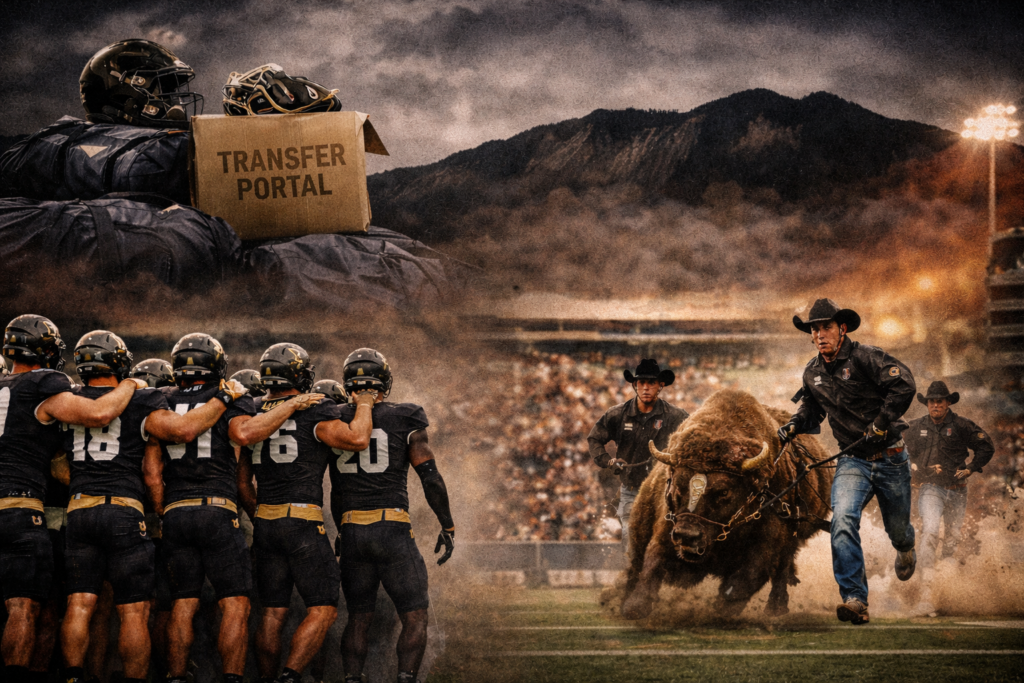
Deion Sanders built the CU football program with the transfer portal as its foundation. In Year 4, that foundation is showing serious cracks. The overreliance on transfers has created continuity and culture problems that threaten the future of the Deion Sanders regime in Boulder.
Let’s start with the continuity issue.
Statistically, over the last 3+ years, CU has relied more on transfers than any other program in NCAA football history.
In Year 1 and even Year 2, that made sense. The team that Deion Sanders inherited won only one game and was one of the worst teams in college football. The portal was a life raft.
But by Year 4, the ship should be sailing under its own power.
This is now all on Deion Sanders.
When your talent base is mostly players who’ve already left one situation for a “better” one, you can’t be shocked when they price-shop again for a few more snaps or a little more coin. There’s no allegiance to CU. The result is a program with record low year-to-year continuity and where the fan experience is forced to reset every August. New names, new numbers, new social media handles on the back of practice jerseys.
This offseason alone, CU’s best defensive player (Tawfiq Byard) and one of its top offensive players (Omarrion Miller) have entered the transfer portal. Other outgoing transfers include DL Tawfiq Thomas, WR Dre’lon Miller, DL Alexander McPherson, DL Christian Hudson, DL Gavriel Lightfoot, OL Tyler Brown, OL Carde Smith, DL Brandon Davis-Swain, safety TJ Branch, DL Jaheim Oatis, cornerback Teon Parks, safety Noah King, and linebacker Mantrez Walker.
One source told me to expect “2 or so” more outgoing high-level transfers in addition to several more outgoing lower-level transfers.
And before you say that’s just modern college football, consider this:
The average team in this year’s NCAA football playoffs returned more than 55 scholarship players, providing cohesion and institutional knowledge. Oregon, a playoff team, had just 25% of its roster comprised of newcomers. CU? Roughly 70% off its roster in 2025 was new. The difference is stark. Continuity matters. It breeds chemistry, leadership and buy-in. Without it, you’re rebuilding culture every year from scratch.
Which brings us to the culture issue.
When two-thirds of your roster is new every year, there’s very little opportunity for leadership to take root. Veteran players don’t stay long enough to mentor younger players, and the kind of internal accountability that makes great programs resilient simply doesn’t have time to take hold.
Accountability can’t be built when no one knows what the standards are.
What you get is less of a team and more of a co-working space—independent contractors in shoulder pads, sharing a sideline for a few months before moving on.
Complaints about the team not singing the fight song or not running behind Ralphie might seem trivial. But they’re symptoms of a program that hasn’t figured out what it wants to stand for beyond NIL deals and Instagram reels.
When a huge chunk of your contributors weren’t even on campus 6 months ago, cohesion is thin. Adversity breaks a team. How do you sacrifice for the guy next to you when you barely know him?
Yes, folks, this matters when it comes to wins and losses. Culture wins games.
Please know that this isn’t a knock on the players. Instead, it’s a reflection of the system they’re dropped into. Loyalty and culture aren’t inherited. They’re built, through blood and sweat and tears. CU’s current approach leaves no time for any of that.
And so I stared at a blank screen, trying to figure out how to stay hopeful when I genuinely dislike Colorado football right now.
And then it hit me.
I know how to fix it.
And the best part? It doesn’t require Deion Sanders to overhaul his core philosophy and abandon the transfer-heavy strategy that’s become his signature (and Sanders has shown that he refuses to abandon this strategy even though I think he needs to rethink it.)
Thanks to the House v. NCAA settlement, FBS programs can now offer up to 105 scholarships. Yet over the last three years, CU has hovered around 80 scholarship players. That’s not because there’s no room. It’s because the program has chosen not to pay for those final 25 scholarships, likely assuming those back-end players wouldn’t contribute immediately and that the expected added cost (about $1m) isn’t worth the hassle.
That’s a mistake.
Those 25 extra scholarships are an opportunity to build a foundation.
CU needs to use those scholarships to bring in high character high school recruits. Think the kind of kids who might otherwise end up at Mountain West or Big Sky prorams. The kind of players that walked on at Nebraska in the 1990s or that are joining the South Dakota States of the world today. Players who cost little to no NIL but want the chance to prove themselves at the highest level.
Even better, recruit them from Colorado. Recruit the players that are ranked in the 20-40 range in the state and that are high character players. Let them be the backbone of the program.
Find grinders, glue guys, long-haulers.
While some of them will never see the field, others might become real contributors. But more importantly, these players will bring CU something that it sorely lacks — stability.
These are the kinds of players who will stick around for four or five years. The ones who will carry the locker room culture forward when 50 new guys arrive every spring. The ones who will show the incoming transfers where the weight room is, where the Duane Physics building is, and how to sing the fight song. Most importantly, these are the players that can show the newcomers what the expected standard is for them as football players for the University of Colorado.
These are your “coach on the field” type guys. Your scout team all-stars. Your “next man up” guys when injuries hit in November.
In short, they’re program players. CU hasn’t had them. And CU desperately needs them.
Deion Sanders can still pursue blue-chip transfers. But he needs to stop building a new team every year.
By using those 25 scholarships on program players, Deion Sanders and CU can start to build a culture that the incoming transfers need to adhere to.
If you’d like to read more from BuffsBlog, read about the CU hoops team at:
Or read about how Brennan Marion is going to marry his Go-Go offense with a non-running QB in Juju Lewis, only at:
Fantastic insight and the best CU coverage there is — continually.
Thanks John.
Thanks DWB!
An interesting thought. I saw you and Brian Howell discuss this issue over twitter and I was surprised that Brian was against this idea. I agree that if you can find program players that reinforce culture and continuity, then the $1m cost is well worth it.
Always fun to read your articles. Deep insight and understanding of politics and history in regards to Colorado ball. Happy New Year!
Thanks Clare! Merry Christmas!
Excellent idea and solid plan. The foundation of CU football has been built on sand and it needs fortification for long term stability.
Thanks Pogi. Happy Holidays!
I think Primes original plan was to build a growing group of 10-15 freshman every year that would become the core. The problem is that the 4 star guys aren’t staying. O miller has a good year and leaves to get paid. D miller gets reps he did not deserve and leaves to get paid, mcphearson leaves to get paid. It’s either that or we believe that a guy who recruited Hunter to Jackson State can’t get kids to buy into a program. We need to be straight up, last year we really wiffed on inside linebacker and qb. I think the issue is not continuity with this plan the issue is that if you get your analysis wrong you have a 3-9 season. Shurmers offense could never adapt to a qb who did not have the talent that Sheduer had, not only physically but mentally. Livingston’s defense relies on great linebacker play, remember how bad our d was in 2024 before NHG started playing and Bentley put it together. We let NHG go becuase Hart and the player analysis group were idiots and Shurmer and the offenses coaches really failed on the Salter analysis. Would we have been a 9 win team with better lb or qb play, probably not. But probably 6 wins easy with either unit being better.
So he fires both coaches responsible for the bad eval and the director of player personnel. Will we be able to survive in a world where our 2/3 of our best talent leaves every year. With great player eval and better coaching we can win more than we lose. Maybe with Prime and Marion together we can keep more guys and push for more 9 win seasons than 6-7. But more failed player evals like last year and the prime experiment will be a failure. But I will say as much as I liked the offerdahl and finneseth and having 10-15 more of them around to be depth peices would be worth it, they are not really going to help us win games.
Brilliant. Insightful. A chance for CU to breathe new life.
Mustang
LOL. Thanks.
Excellent analysis! I grew up in an era where you played for your school. College football suffers from players who are mainly interested in money and prestige.
I have found myself going back to the NFL because of what is going on in college football. NFL players are all talented to various degrees, get paid, and stick around longer because of their contracts.
At this point, money and playing time still doesn’t equate to loyalty in college football.
I understand this perspective and think it could increase if big changes aren’t made to cfb.
Sanders mentioned implementing a salary cap in CFB at one point and that thought deserves discussion. There needs to be some discussion about NIL player contract duration as well. Wild times in CFB!
Solid article.
I’m curious how CU’s use of 80 scholarships compares to the other Big 12 schools. If CU wants to show the Big Ten they are a viable expansion candidate, they must spare no penny on football. And after those sellouts, why can’t CU just spend that $1M for every remaining scholarship? I think getting that count up to 90-95 would be ideal as setting aside 10-15 scholarships for walk-ons still allows players the opportunity to prove themselves.
The need to build a team over time reminds me of how the 2016 team was built. I’m not so sure today’s college football affords that kind of patience especially when it comes to the ability of players to enter the transfer portal for more playing time.
I think you’re spot on. CU needs a cultural identity, and without continuity, culture is a challenge. Culture is taught, learned, mentored, absorbed. I don’t see that at CU. I love the idea of offering more scholarships to the “grinders, glue guys, long-haulers.” What you’re describing – I think – is a program built on player development – bring in the 2-3 star guys with something to prove, and see what happens. However, I don’t think Deion and his crew can develop – not sure they want to develop. That’s not the mentality, and i don’t know that it’ll be that easy to have the portal-first philosophy meld well with a development approach. Moreover, culture starts at the top, and while those guys will bust their ass to be next guy in, unless Prime and he coaches are bought into a bottom up, everyone matters approach, it’s unfair to think 25 guys on the scout team can build culture. I think Deion would need to take a few pages (chapters?) to a program like Iowa or Wisconsin to see this approach bear fruit.
So…I like the thought, definitely think it’s worth a shot, but don’t think Deion is the guy to implement it. Good luck.
I think it’s fair to question whether Deion Sanders will do this. I think he should, but I don’t have a lot of faith TBH.
I like the article. I hope with Lovo, Marion and some new ACs things hopefully trend in that direction. Prime being healthy and here during majority of summer will help. In looking at the transfer portal as a whole, I am amazed at the sheer # of 4* HS recruits into the portal from all different teams. I think some of this is NIL/Agent driven. If the 4* is not on schedule and/or wants more $$$, but school does not find that player worthy to resign, I think those guys will hit the portal. With the guys we are losing to the portal, it does not seem to matter if you find the field early or red-shirt, as much as it is about whether the player and/or program feel they are on schedule. Tough for these young HS recruits to have patience.
I’m curious, what are your thoughts on S&C coach Swasey and his assistants? Do you know if they are well liked by the team? Good fit? He came highly regarded from Miami, but I sort of felt like a bunch of players including certain transfers were sort of playing themselves into playing shape during the regular season. Some of this might be Prime’s absence or team leadership issues, however per NCAA rules, isn’t post-season to Spring and post-Spring into Summer periods mostly directed by the S&C coach/staff.
Funny you ask about S&C — BuffsBlog has a new contributor that is going to debut soon that is a S&C guru. I will forward him your question and get his thoughts on your question and circle back.
Thanks and I look forward to it.