We are in the Karl Dorrell 2.0 era: Five things after Oklahoma State
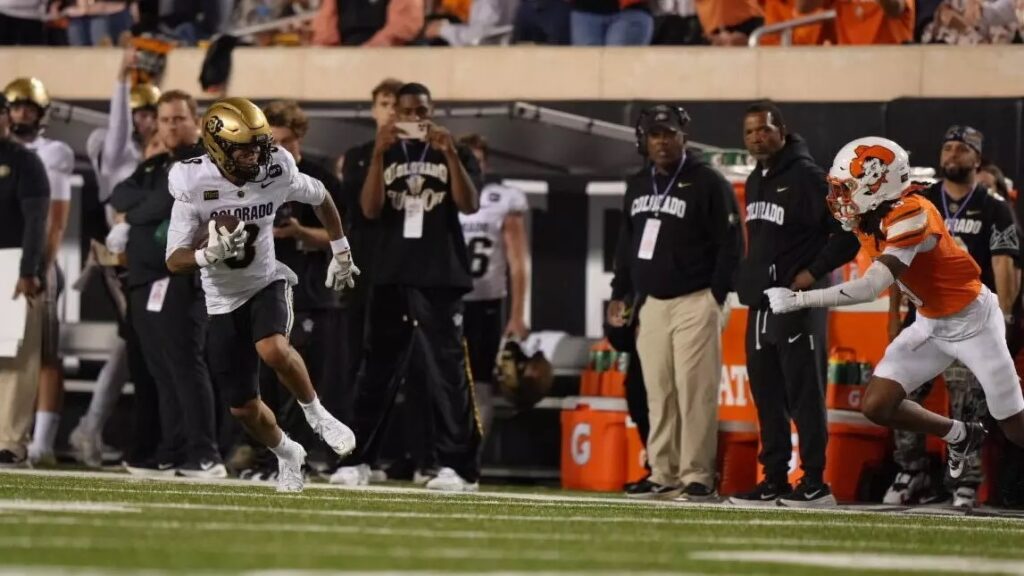
Karl Dorrell went 5-15 in his final 20 games at Colorado. Four of those losses came by at least 30 points.
Deion Sanders is 5-15 in his last 20 games at Colorado. Four of those losses came by at least 30 points.
Brian Howell flagged that comparison after Saturday’s 57-24 loss at Oklahoma State. I went back through the schedules. He’s right…and shortening the window doesn’t help Sanders, either.
| Comparable stretch | Dorrell ending at dismissal | Sanders through Oklahoma State |
| Last 20 games | 5-15 | 5-15 |
| Last 15 games | 3-12 | 3-12 |
| Last 12 games | 3-9 | 2-10 |
| Losses by 30+ in those last 12 | 2 | 4 |
Here is the part that should bother you: Sanders’ blowouts are BIGGER. Dorrell’s four were by 32, 30, 31 and 42. Sanders’ four were by 46, 35, 34 and 33. Three of them have come in the last thirteen months.
The Dorrell era is remembered as rock bottom. It is the thing CU fans point to when they want to describe how bad it can get. We are there again, right now, and we are paying more than $10 million a year to a head coach for it.
The excuses don’t transfer
Here is where someone tells me the situations aren’t comparable.
They’re right.
Dorrell was recruiting through COVID. He had essentially zero NIL, because Rick George didn’t prioritize NIL. Transfer admissions at CU were restrictive to the point of being a competitive disadvantage. Dorrell was asked to win Pac-12 games with a roster assembled under those conditions.
Sanders has the opposite of all of it. National attention no CU coach has ever had. A portal operation that rebuilt the roster twice. NIL money. A department that has given him everything he asked for, including a five-year, $54 million extension in March 2025.
Better roster. Better resources. Better recruiting conditions. Very, very similar results.
What a change actually costs
Sanders’ deal pays him $10 million this season, $11 million in 2027, $11 million in 2028 and $12 million in 2029. After this year, that’s $34 million in guaranteed salary across three seasons.
Fire him without cause and CU owes roughly 75% of what’s left. Call it $25.5 million, paid out across those same three years. That is about $8.5 million a year to have him not coach, against $11.3 million a year to have him coach. Firing him, all by itself, SAVES Colorado about $2.8 million a year.
Then you have to hire somebody.
Here is On3’s 2026 salary list, Big 12 only:
| Coach | School | 2026 salary |
| Deion Sanders | Colorado | $10.0M |
| Kyle Whittingham | Utah | $8.0M |
| Kenny Dillingham | Arizona State | $7.4M |
| Sonny Dykes | TCU | $7.0M |
| Lance Leipold | Kansas | $6.7M |
| Joey McGuire | Texas Tech | $6.5M |
| Dave Aranda | Baylor | $4.7M |
| Willie Fritz | Houston | $4.5M |
| Scott Frost | UCF | $4.2M |
| Collin Klein | Kansas State | $4.1M |
| Eric Morris | Oklahoma State | $3.8M |
| Scott Satterfield | Cincinnati | $3.8M |
| Rich Rodriguez | West Virginia | $3.6M |
Read that table again. Deion Sanders is the highest-paid coach in the Big 12 by TWO MILLION DOLLARS. The median is $4.7 million. Seven of the thirteen make $4.7 million or less. The five cheapest average under $4 million.
And look at the bottom of that list, because that is where the conference is actually being won. Eric Morris makes $3.8 million. His OSU Cowboys just scored 57 points on the Buffs. Rich Rodriguez makes $3.6 million. Collin Klein, who brings Kansas State to Folsom on Saturday, makes $4.1 million.
So here is the real math. Buyout plus a new coach at the Big 12 median of $4.7 million is about $39.6 million over three years. Three more years of Sanders is $34 million.
The entire cost of firing Deion Sanders and hiring a median Big 12 coach is about $1.9 million a year.
Hire at Collin Klein’s number and it’s $1.3 million a year.
Hire at Eric Morris’ salary level, the coach who just beat us by 33, and the whole thing costs Colorado less than $1 million a year.
That is the price of getting out. For a department that handed one man a $54 million extension in March 2025, it is a small amount. We are paying the most money in the Big 12 and sitting alone in last place, and the exit is cheaper than a mid-tier assistant pool.
This is Fernando Lovo’s first real test. He took the AD job in December. He did not hire Sanders, which means he can evaluate him honestly, and he inherits a decision his predecessor was never going to be able to make. Lovo does not have to say anything in October. But he should know the math, and now so do you.
Onward, Buff fans. Five things.
1. The second half is the problem
Colorado led 24-23 at halftime in Stillwater. Isaac Wilson was 14-of-16 for 222 yards with two touchdown passes and a rushing score. His first-half passer rating was 245.3. He outplayed Drew Mestemaker, a projected top-five pick.
CU scored on four of five real possessions. The Buffs committed three penalties.
It was CU’s best offensive half all season. We were go-going.
And then halftime, and then coaching adjustments.
And then pain.
Isaac Wilson fumbled on the first snap of the third quarter and Colorado never scored again.
Oklahoma State closed the game on a 37-0 run. CU’s eight second-half possessions produced three turnovers, four punts and the clock running out. The Buffs committed eight more penalties after halftime.
“When adversity hit right after halftime, we didn’t handle it whatsoever, and it just snowballed,” Sanders said.
He is describing his own team’s response to a fumble on the 13-yard line, in week eight, in year four. Teams take their personality from their head coach. A team that goes 37-0 in the wrong direction after one bad play is telling you something.
And if this felt familiar, it should. In 2023 CU led Stanford 29-0 at halftime and lost 46-43 in overtime.
Different roster, same head coach.
2. The defensive improvement I wrote about last week may be schedule-dependent
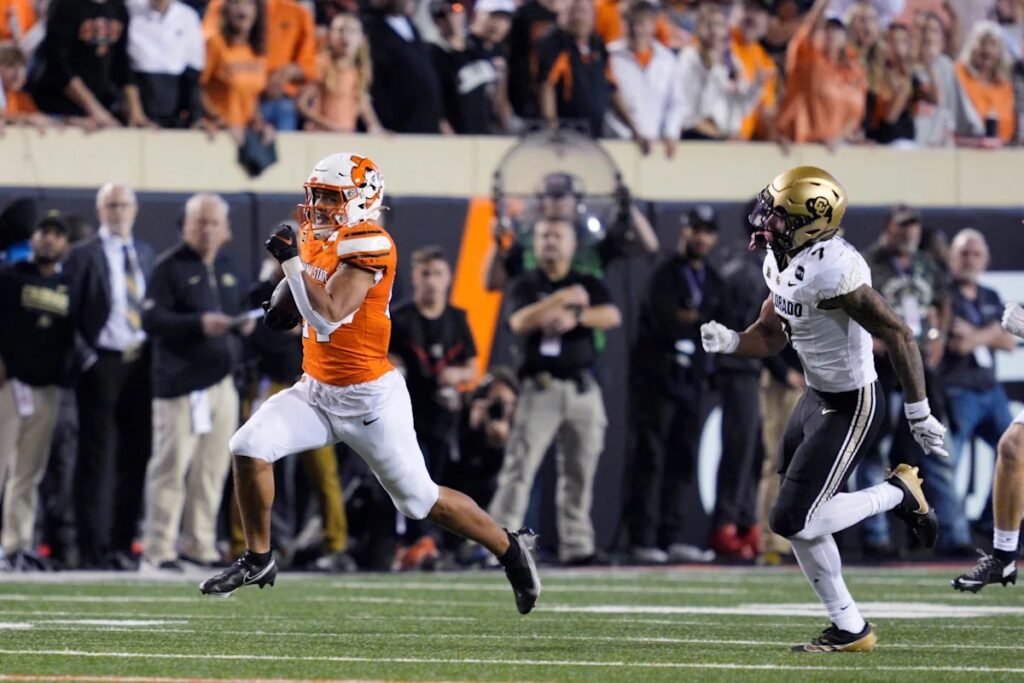
Over three conference games, CU’s opponent yards per pass attempt dropped from 10.4 against Georgia Tech and Northwestern to 6.0 against Baylor, Texas Tech and Utah. The Buffs held Utah to 27 points when nobody else had held the Utes under 30 all season.
Then Colorado played a team with a quarterback. Drew Mestemaker went 21-of-36 for 386 yards and four touchdowns. Oklahoma State gained 598 yards, the most CU has allowed since 2022, and scored on 11 of 13 possessions.
The Cowboys averaged 10.8 yards per pass attempt.
Deion Sanders, to his credit, said the honest thing: “They tested our corners, and we didn’t do well versus opposition. That was one of the first teams who really tried our corners.”
Baylor, Texas Tech and Utah did not try to push the ball downfield repeatedly against CU. Oklahoma State did, and CU had no answer.
RJ Johnson allowed five catches on seven targets for 121 yards and a touchdown. [Johnson gave up one catch for 12 yards against Texas Tech and four for 35 against Utah, so this is not a referendum on him. It’s a referendum on what happens when a dynamic passing offense plays against a defensive backfield that isn’t elite.] Justin Bowick went for 138 and a score on five catches, 104 of them against Johnson. Cree Thomas gave up a 28-yard touchdown. Boo Carter got flagged for holding.
Against 4 and 5 WR sets, CU had to put linebackers in coverage, and Mestemaker hunted those matchups all night. Gideon Lampron finished with a 29.6 coverage grade on 47 coverage snaps, and was targeted 10 times, giving up 8 catches and 130 yards.
The defense is better than it was in September. It still isn’t consistent, however, and it is extremely vulnerable to teams that try to push the ball downfield.
3. There is still no quarterback, and the season-long numbers say both of them
Isaac Wilson’s first half was the best 30 minutes of quarterback play CU has gotten this season.
It doesn’t erase the 2nd half (nor the rest of his season).
Through five games, Wilson is 77-of-130 for 979 yards, 6 touchdowns and 7 interceptions. He completes 59.2% of his passes. He has 10 turnover-worthy plays against 4 big-time throws. Two more interceptions Saturday, both in the second half, one of which handed Oklahoma State three points and the other of which killed the only drive that could have made it a game.
Juju Lewis’s stat line is arguably better: 61-of-95 for 733 yards with 6 touchdowns and 2 interceptions. Better completion percentage, better yards per attempt, far better turnover ratio.
BUT (and there’s always a BUT with CU football). Under pressure, Lewis has taken a sack on 31.0% of his pressured dropbacks. Wilson’s figure is 13.3%. Lewis’ average depth of target is 7.6 yards; Wilson’s is 10.4. One of them gets rid of it and throws down the field. The other holds it and goes down.
So CU has a quarterback who throws it away to the other team and a quarterback who takes way too many sacks. Both are young, both will be better, and neither of them is the sole reason this team is 2-5. But four games from the end of year four of the Deion Sanders Experience, and “we don’t know who our quarterback is” is the answer to a different question.
Sanders on Wilson earlier this month: “We don’t count his mistakes.” Through five games the mistakes are 7 interceptions and 10 turnover-worthy plays.
Somebody has to count them.
4. The run game vanished, and the Go-Go cannot survive that
One week after Colorado ran for 5.8 yards a carry against Utah and finally looked like a physical offensive team, the Buffs ran 30 times for 56 yards.
One point nine yards a carry.
Now the caveat. College statistics subtract sacks from rushing. However, removing Oklahoma State’s four sacks for 13 yards only gets the Buffs to 69 yards on 26 attempts: 2.7 yards per rush.
Smith gained 37 yards on 12 carries. PFF credited him with 34 yards after contact. That leaves three net yards before contact across those carries. That’s not good enough run blocking. It also suggests that telling Smith to run harder, which was something that I saw fans excrete on twitter during the game, is not a particularly sophisticated solution.
When the run game contributes so little, the offense keeps asking its quarterback and receivers to rescue possessions. They did it early. They could not sustain it.
One personnel development deserves attention: Xavier Payne played 31 snaps at left tackle and allowed no pressure in PFF’s charting, earning an 84.3 pass-blocking grade. Payne has been beat up, but he’s playing well and the true freshman will be a cornerstone player for this program going forward..if he sticks around.
5. CU football existed before Deion Sanders, and it will exist after him
There is a thing I keep seeing, mostly from people who discovered this program in 2023, that CU football was nothing before Deion Sanders got here and will be nothing when he leaves. That the stadium will empty. That nobody will care.
It is an incredibly ignorant claim.
Colorado won a national championship in 1990. Bill McCartney took a program that went 1-10 the year he arrived and made it a national champion. Rashaan Salaam won the Heisman Trophy in 1994. Kordell Stewart threw the Miracle at Michigan. CU won the Big 12 in 2001 and beat No. 2 Nebraska 62-36 to get there. The program has produced 32 consensus All Americans and all-time greats like Joe Romig, Bobby Anderson, Alfred Williams, Deon Figures, Chris Hudson, Michael Westbrook, Eric Bieniemy, Matt Russell, Daniel Graham and Phillip Lindsay.
Before Sanders coached his first game, Colorado had already won 719 games. Its all-time record through 2022 was 719-536-36, a .571 winning percentage. CU’s preseason 2023 notes placed it 30th nationally in total wins and third among the then-Pac-12 schools, behind USC and Washington. That was the program’s documented history when Sanders arrived.
Here are some useful comparisons, all frozen at the end of 2022 so none of Sanders’ wins are included:
| Program | All-time record through 2022 | Winning percentage |
| Michigan State | 726-479-44 | .599 |
| North Carolina | 721-564-54 | .559 |
| Colorado | 719-536-36 | .571 |
| Utah | 711-477-31 | .596 |
| Missouri | 700-588-52 | .542 |
| Oregon | 693-509-46 | .574 |
Sources: CU’s 2022 season-end comparison table, page 20, and Oregon’s 2023 record book. Winning percentage counts a tie as half a win; these are whole-program records, not head-to-head results.
CU entered the Sanders era with more wins than Utah, Missouri and Oregon. It was seven wins behind Michigan State. Its winning percentage was higher than North Carolina’s and Missouri’s, and just three thousandths below Oregon’s.
And in October 2022, with a winless football team and a fired head coach, more than fifty thousand people packed Folsom Field to watch CU beat Cal, and then they stormed the field.
That is the fan base. It was here before the cameras showed up and it will be here when they leave, because the cameras were never why any of us cared.
Deion Sanders brought attention. He brought money and eyeballs and one of the best players in CU history in Travis Hunter. Nobody is taking that away from him, and if you came to CU football because of him, you are welcome here, genuinely.
But you are watching a 2-5 football team that has lost five straight, sits alone in last place in the Big 12, and has matched the worst twenty-game stretch of the worst era in the program’s modern history.
We were here before Deion Sanders. We will be here afterward.
Go Buffs.
Where this leaves us
CU plays Kansas State at home on Saturday, October 31, at noon on TNT. Then Arizona State, Houston, Cincinnati and UCF. Bowl eligibility requires four wins from here, and I’d be surprised if CU won two.
The Buffs are 2-5, 0-4 in the Big 12, and 5-15 over their last twenty games.
Karl Dorrell was fired at 0-5 after twenty games that looked exactly like these.
I don’t know what Fernando Lovo is going to do. I know what the numbers say, and I know they cost less than $2 million a year to act on.
Fernando Lovo’s first defining test is whether the university is prepared to act like it knows that, too.
Other Things That Interest Me, Which Have Nothing To Do With CU Football
- I was in Michigan this past weekend for the Michigan vs. Indiana game and the Detroit Lions vs. Green Bay Packers games. Oh yeah, I also saw my two kids at the University of Michigan. My quick takeaways: I’d rather have Brennan Marion than Jason Beck as my offensive coordinator. And both CU and Michigan have very, very similar offensive issues. And I say this as a Denver Bronco season ticket holder: Ford Field was LOUD from Sunday’s game — my ears are still ringing. Jahymr Gibbs is worth the price of admission, too.
- How to win at the most popular board games, almost all of the time. Win > 90% of the time at Connect Four, Jenga, Tik Tan Toe and more. https://www.youtube.com/watch?v=26P1KyvrmjI
- A not very brief video on the history of the Wing-T offense. https://www.youtube.com/watch?v=WgzUpx2KZss&t=995s
- A more positive look at the future of AI from Vankatash Rao: “AI may make intelligence abundant without making people useless. Much of today’s anxiety may confuse those two possibilities.” https://contraptions.venkateshrao.com/p/cognitive-mercantilism
This Week in CU Athletics, Sponsored by SportsDeck
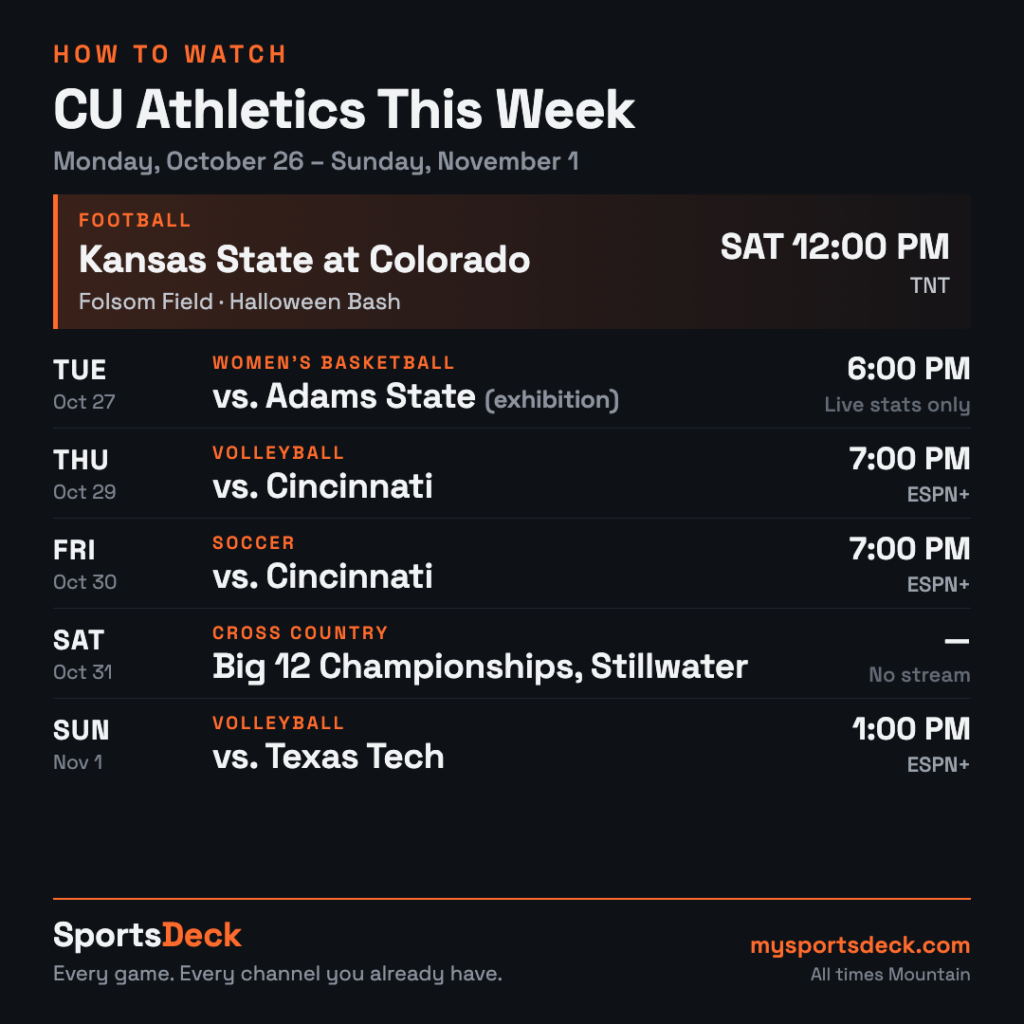
Football: Kansas State at Colorado
Saturday, Oct. 31, 12:00 p.m. on TNT. Folsom Field, for the Halloween Bash.
Volleyball: vs. Cincinnati, then vs. Texas Tech
Thursday at 7:00 p.m. and Sunday at 1:00 p.m., both at the CU Events Center. Both on ESPN+.
Soccer: vs. Cincinnati
Friday at 7:00 p.m. at Prentup Field, on ESPN+.
Women’s Basketball: vs. Adams State
Tuesday at 6:00 p.m. at the CU Events Center. Exhibition, live stats only.
Also this week
Cross country runs the Big 12 Championships on Saturday in Stillwater, with no stream.
This section is sponsored by SportsDeck, an app I built after getting tired of finding out my team had played yesterday, on a channel I already had.
Here’s how it works:
You tell it which teams you follow (there are 3,220 teams on SportsDeck across 47 sports leagues) and which streaming and TV services you already pay for. SportsDeck tells you every game your teams play, what time it starts, what channel or app it’s on, and whether you can actually watch it with what you’ve got. It can even show you whether there’s a cheaper way to watch more of your teams’ games.
Then it does the part I’m proudest of: it brings together your teams’ news, podcasts, YouTube videos, and trusted local coverage in one place—like the old sports page you miss, rebuilt for today’s world. SportsDeck has 454 of these pages, and I built and curate the whole operation.
You can also get a morning email with your games, viewing information, and biggest team stories before your coffee. There are game alerts and an iPhone widget, too.
Your first month of Pro is free. Get the iPhone app or start at mysportsdeck.com.
Last Week on BuffsBlog
Five Things I Think We Learned About CU After Utah
CU held Utah to a season low and still lost. The penalties are why.
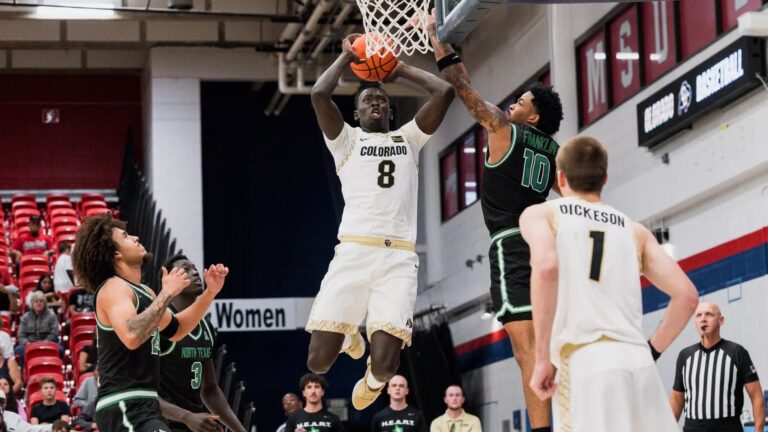
Colorado 67, North Texas 64: A Win, a Warning
Chris Gaddis on the hoops exhibition, and a 29-shot deficit.
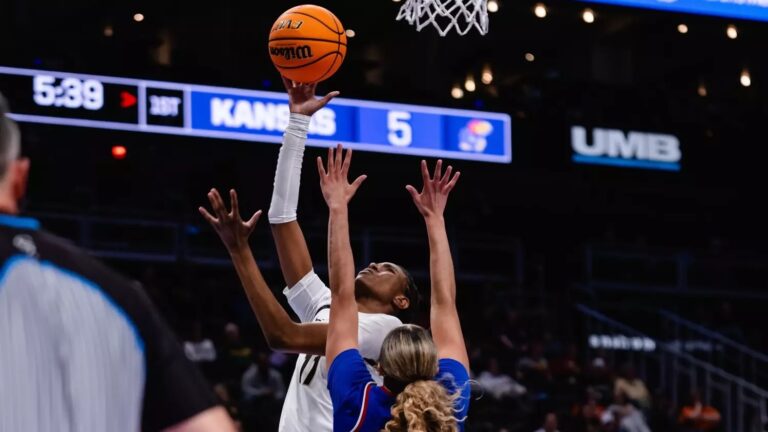
Ten Reasons CU Women’s Basketball Will Be Dancing in March
JR Payne’s roster looks like an NCAA Tournament team.
I look at guys like Brent Brennan at Arizona, Bob Chesney at UCLA, Willie Fritz at Houston, and Lance Leipold at Kansas, and I see coaches who understand that rebuilding a football program isn’t about winning the press conference. It’s about establishing an identity.
Toughness. Discipline. Accountability. Player development. A system that survives beyond any one player or recruiting class. It’s not always pretty, and it certainly isn’t flashy, but it’s how sustainable programs are built.
And then there’s Colorado.
When your system seems to revolve around a camera and your philosophy is more about being cool than establishing any discernible cultural identity, well, you get:
18–26 overall under Prime
9–22 in conference games
9–22 outside the 2024 season
2–23 in conference play outside 2024
1–12 in Big 12 play since the beginning of 2025
3–9 in 2025, followed by a 2–5 start in 2026
0–4 in Big 12 play this season
Outscored 211–141 in 2026
Lost 41–7 to Northwestern
Lost 57–24 to Oklahoma State
The most damning part isn’t the losses themselves. Rebuilding programs lose. It’s that four years in, I still couldn’t tell you what Colorado football is supposed to be.
What do we do well? What is our identity? What foundational principles are we building around? What is the one thing an opponent knows it’s going to have to deal with when it plays Colorado?
Take away the cameras, the celebrity, the social media attention, and the slogans. What’s left?
Sometimes I think Deion Sanders views CU as a platform to sell more TV shows, sunglasses, and medical products. Exhibit #32: Deion Sanders wears “Coach Prime” gear in his press conferences just as often, if not more often, than “Colorado” gear.
Well said.
What about the cost to pay off all the assistant coaches?
THat’s the next article. 🙂
I pay for 2 separate CU websites and this is BY FAR the best CU coverage there is — and it’s free. I can’t believe someone hasn’t tried to scoop you up. Thanks for all of your fantastic work here.
Thanks Erich!
My concern is that Jason Eck will have options at the end of this year. and that $4-5m won’t be enough to afford him. He’s a coach’s coach and has built winners without elite resourecs. Idaho reached the FCS playoffs in all 3 of his seasons, and New Mexico was 9-4 in his first year. He also develops great offensive lines. I know Fernando Lovo hired him at New Mexico, and that he thinks the WORLD of him. I hope we can afford him if we have to pay off “Coach Prime.” [For the record I still can’t believe we have a head coach that we have to call “Coach Prime”.]
Eck would be a massive upgrade in the Xs and Os department. I think he’d love to work with Lovo since there’s a familiarity there, but you might be right re: salary demands.