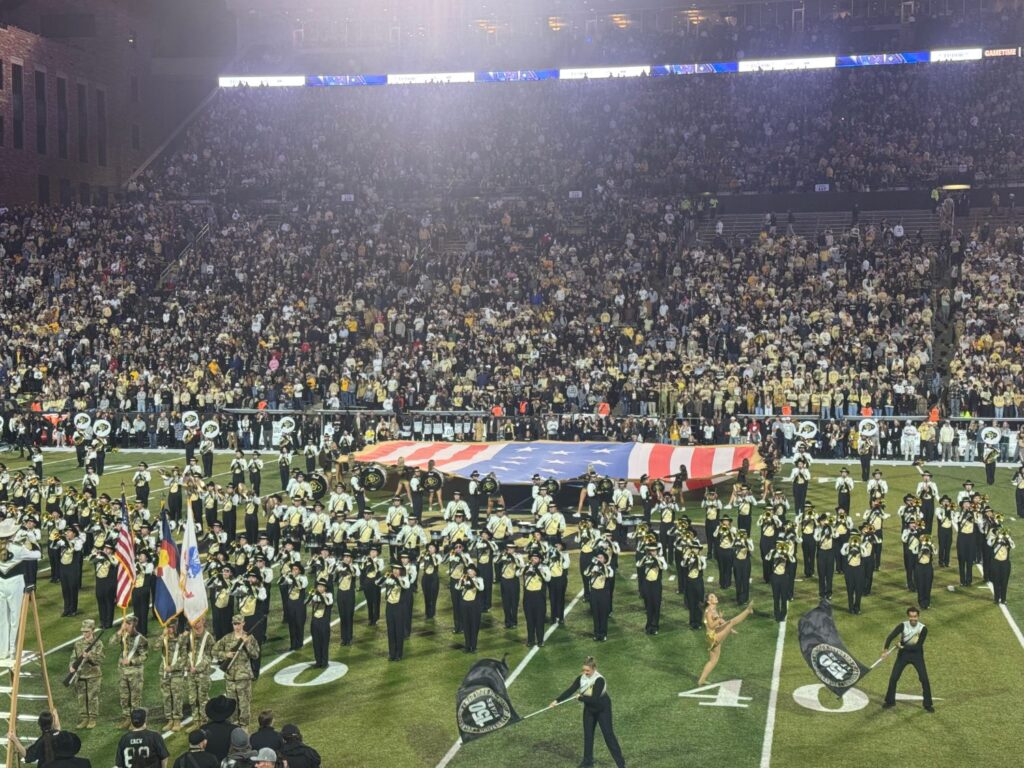
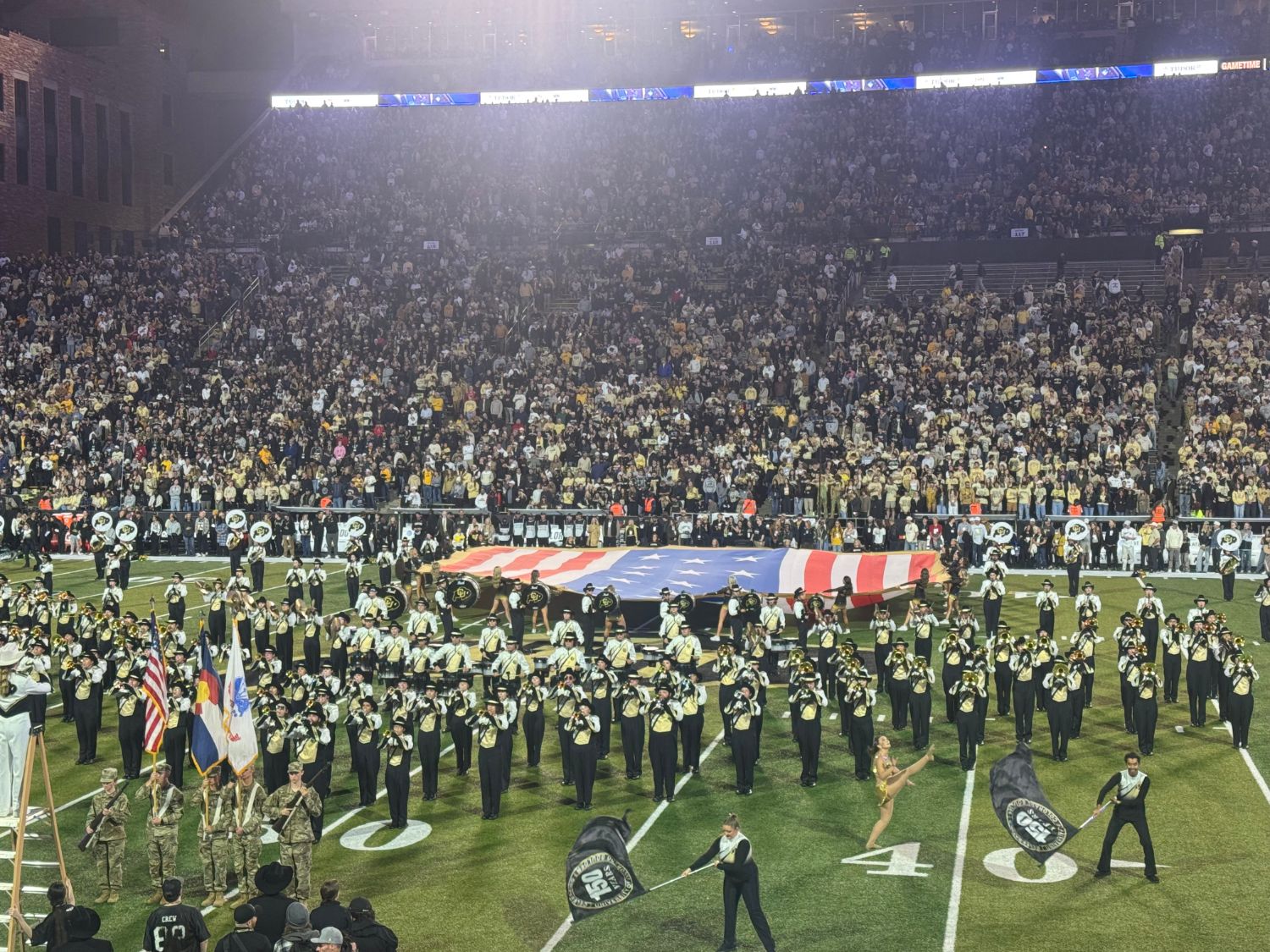
There was, finally, a pulse.
After a dismal first half that saw CU with more penalty yardage (82) than actual, you know, yardage (70), CU’s offense decided to show up.
Isaac Wilson helped CU get back on track against his former team and pulled CU within a field goal with 1:21 remaining. Utah recovered the onside kick only to punt with just a minute left, setting the stage for a pitch-back play that upon review was ruled an illegal forward pass. The Utes then defended a final pass attempt and won the game, 27-24.
The good news is that CU didn’t give up. The bad news is that it still wasn’t enough.
The Buffs are 2-4, 0-3 in the Big 12, and they have lost four games in a row and eight consecutive conference games.
Deion Sanders said afterward that he told the team he was proud of them, which he said he never does. He is not wrong that they fought. They were 15-point underdogs, and they had a 55-yard field goal attempt to tie it snuffed out by a replay review.
So close. Yet so far.
Let’s do this — five things.
1. Penalties remain a massive reason why this team loses
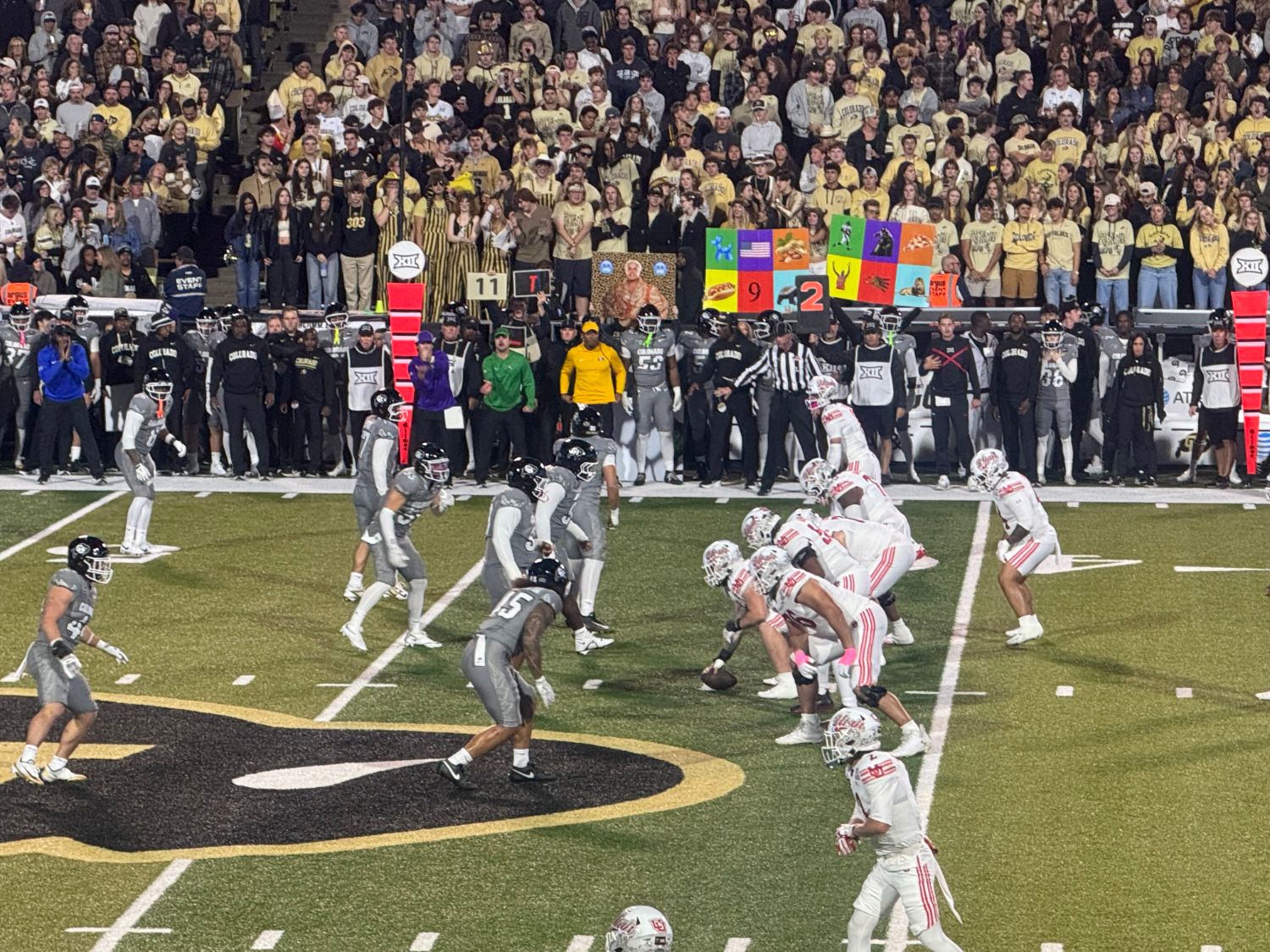
Colorado committed 10 penalties for 93 yards on Saturday.
That is not an aberration. That is a slightly worse than average Saturday.
| Colorado, six games | Total |
| Penalties | 55 |
| Penalty yards | 506 |
| Penalties per game | 9.2 |
| Penalty yards per game | 84.3 |
The Buffs have gained 2,365 yards of offense all season and handed back 506 of them in penalty yardage. That is BY FAR the worst offensive yards-to-penalties ratio in the country.
Read that again — CU is 138th out of 138 division 1 football teams in yards-to-penalties ratio in the country.
Put it next to the run game and it gets worse. Colorado averages 140.3 rushing yards a game and 84.3 penalty yards a game. Every week, the Buffs penalize themselves about 60 percent of what they gain on the ground.
As noted in the opening of this post, in the first half Saturday CU had 82 yards in penalties and 70 yards of offense.
And this was coming off a bye week, when CU was able to “work on all the little things.”
Focusing on the “little things” hasn’t seemed to work. The team’s pace of penalties hasn’t improved over the season.
| Penalties | Yards | |
| Games 1-3 | 28 | 247 |
| Games 4-6 | 27 | 259 |
Now, two honest caveats, because I was sitting there and I watched it.
Not all ten of the penalties were earned. The 15-yard hit out of bounds call on a CU defensive back was a bad call, and it was a costly one, because it extended a Utah drive. And CU’s defense was tired at the end of the first half and got flagged three times for 28 yards on Utah’s 17-play field goal drive, the one that ate nearly nine minutes and put the Buffs down 10-0. It’s tough to play penalty free when your side of the ball is on the field for almost an entire half.
Strip the awful late hit call out, though, and CU still committed nine penalties for 78 yards. That is almost exactly the season average.
Dumb penalties are fixable problems, usually, but they have not been fixed in six attempts. Penalties are not a talent issue or a money issue. They are what a staff tolerates in practice, and this staff has tolerated it all year.
And then there is this. Asked about Isaac Wilson turning the ball over five times in two games, Deion Sanders said:
We don’t count his mistakes. We count the passion and the love that he plays with.
Deion Sanders
I understand the impulse. He is protecting a young quarterback in public, and there is a version of that I respect from a head coach.
However, it’s very easy to read this as a statement of how the program operates. Colorado is 55 penalties and 506 yards into a season in which self-inflicted errors are the single clearest reason it has lost football games, and the man in charge says out loud that counting mistakes is not something they do.
Somebody has to count them. That is most of the job.
The same instinct showed up two weeks ago, when a Colorado play sheet ended up in the hands of Texas Tech fans and Sanders waved the entire thing off. A play sheet. Left behind in a local hotel and found by Texas Tech fans. The response was a shrug.
It was a response that indicates to me that Deion Sanders is probably not up for this job.
Attention to detail is not a personality trait you either have or do not. It is a job requirement, and the place it shows up is not in a press conference. It shows up at nine flags a game.
2. Colorado’s running backs are its most productive offensive players
CU’s running backs are running the ball well, despite there being NO running threat from the team’s quarterbacks.
| Who | Carries | Yards | Average |
| Smith, Welch, Henderson, Taylor | 139 | 691 | 4.97 |
| Colorado quarterbacks | 48 | 52 | 1.08 |
Brennan Marion’s Go-Go offense is built on a quarterback run threat. Unfortunately, CU doesn’t have this. The quarterbacks have carried 48 times for 52 yards.
The PFF grades show how good CU’s running backs have been. Four of the seven highest-graded players on this offense are running backs: Henderson at 77.8, Smith at 77.0, Welch at 73.1, Taylor at 71.0. [Isaac Wilson has a 61.7 PFF grade and ranks 21st on his own team.]
Nearly 5 yards a carry is good enough to win a lot of games. And it’s more impressive since CU’s offense is missing a high powered passing game and a QB run threat.
Against Utah, JaQuail Smith got 13 carries, Colorado ran for 5.8 a carry, and the Buffs scored 24 points on the best team they have played.
CU coaches have realized that JaQuail Smith is a heck of a player. Against Northwestern, Smith ran for 91 yards on 13 offensive snaps, per PFF. Against Utah he played 36 snaps and produced 141 yards rushing and receiving. He and DeKalon Taylor combined for 184 yards from scrimmage on 19 touches, which was 47 percent of Colorado’s total offense.
Credit where it is due. The staff gave a productive player more work and he produced. That is an adjustment, and it is the kind this team has not often made.
The standing objection to playing the backs more has been pass protection. [This is another stated reason we’re stuck watching 2 non-threat TEs play 60+ snaps a game.] Saturday might have shown that CU can play the RBs more in pass protection. Smith and Taylor were on the field for 11 combined pass-blocking snaps and allowed zero pressures.
Quentin Gibson is another player that coaches need to come around on. He grades 71.8 and has played 62 snaps in six games. On Saturday he played three snaps, caught two passes for 18 yards, and graded out as the best offensive player on the field.
If I can see it, surely the coaches can see it. Right?!?!
3. The defense is good, and Chris Marve deserves more credit than he is getting
Utah came to Boulder having scored at least 30 points in 11 consecutive games, the longest active streak in the country. What the Utes had done this season before Saturday:
| Utah vs. | Points |
| Idaho | 66 |
| Arkansas | 43 |
| Utah State | 33 |
| Iowa State | 31 |
| Kansas | 41 |
| Colorado | 27 |
Forty-two point eight a game. Nobody had held them under 30 all year, and their previous low was 31 at Iowa State, which has a good defense.
Colorado held them to 27. Four points below anything Utah had been held to in 2026, and the end of the streak.
That was not a fluke, either, which is the part worth sitting with:
| Pass defense | Opponent yards per attempt |
| Georgia Tech and Northwestern | 10.4 |
| Baylor, Texas Tech and Utah | 6.0 |
Across the first two Power Four games Colorado surrendered 10.4 yards every time the other team threw it. Across the three conference games since, 6.0. The opponents are different and it is not a laboratory, but three games in a row is a trend.
Chris Marve has built the one thing on this roster you can count on, and he has done it with a group that lost Jason Stokes Jr., Makari Vickers and Tyler Martinez to injury along the way.
Randon Fontenette has played more snaps than anyone on the defense, 423, and has 49 tackles, four pass breakups, an interception and a forced fumble. Saturday was his best game of the year, an 84.7 PFF grade with 11 tackles, two more breakups and a forced fumble.
Gideon Lampron is right there with him: 384 snaps, 49 tackles, an 80.8 overall grade and an 84.1 against the run. Against Utah he had 11 tackles, 2.5 for loss, a sack, two breakups, and the deflection that Dylan Manuel turned into an interception in the red zone.
Liona Lefau grades 77.4 with the best tackling mark among the linebackers at 80.8, and he misses tackles on only 7.4 percent of his attempts, which on this roster is remarkable. Ten tackles and two for loss on Saturday.
Santana Hopper has 22 pressures on 182 pass rushes. That is a 12 percent rate from defensive tackle, which is a good number for the position, and it does not count the way he collapses the pocket on plays somebody else finishes. He had six pressures against Utah.
Toby Anene has quietly been the most used edge and grades 77.6 across 281 snaps.
RJ Johnson has made two straight starts and allowed two catches for 22 yards in them. On the season: nine targets, 34 yards, a 76.1 coverage grade.
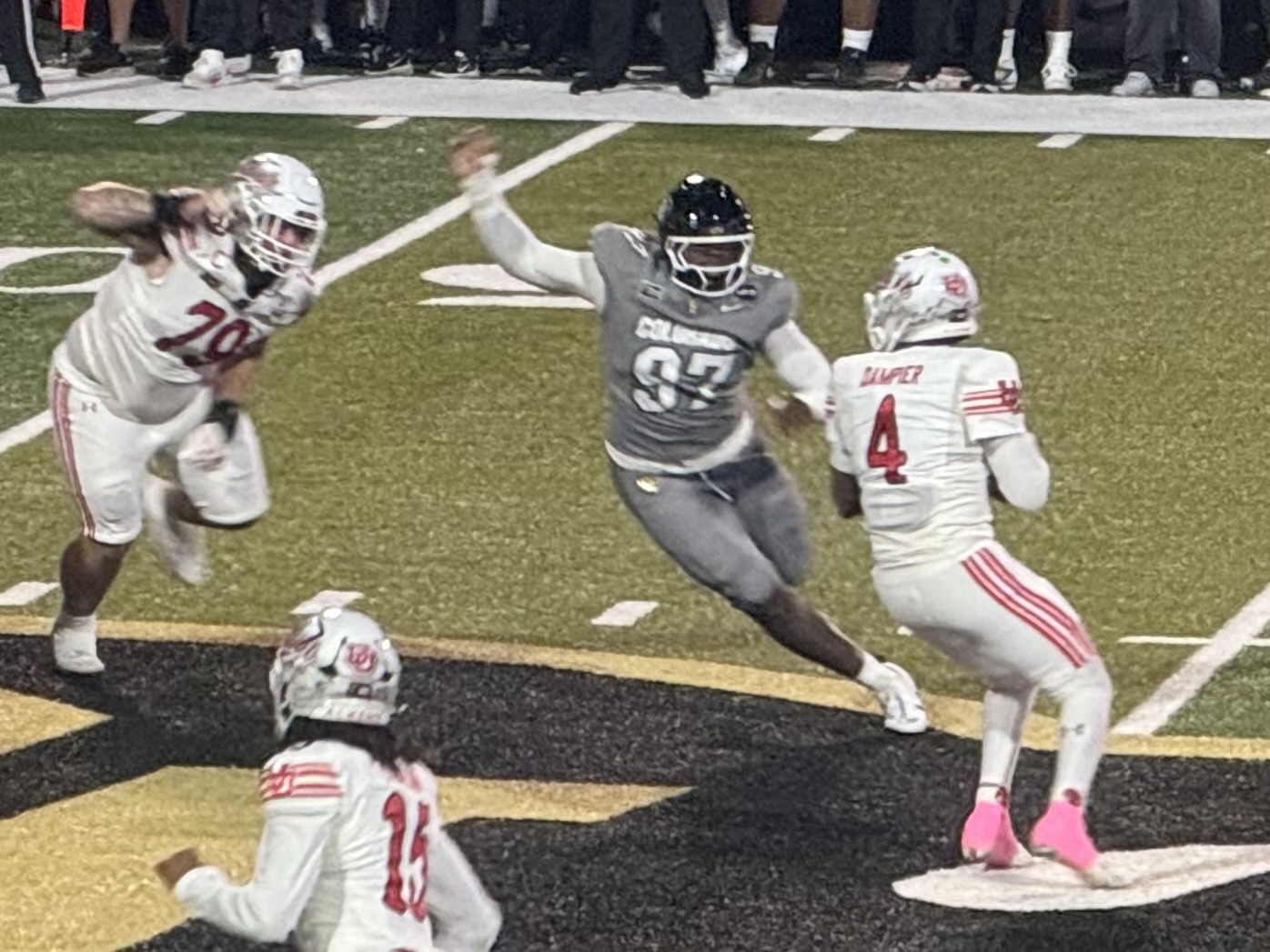
And Naeten Mitchell picked off Devon Dampier in the third quarter after Hopper chased him off his spot, which set up the field goal that put Colorado ahead.
That is a unit, and it is the reason this team was in the game at all.
One thing I would like to see from Marve, and I will keep it modest.
Lamont Lester Jr. has the highest PFF grade on the defense, a 91.0 overall and a 91.9 as a pass rusher, with 15 pressures and four sacks on 89 pass-rush snaps. He plays 28 snaps a game.
Thus far, Lester Jr. is a situational rusher. Most of his snaps come on obvious passing downs, and his tackling grade is only 44.7. A specialist used in his best spot on a small sample produces a number that runs hot. So I am not going to tell you he is secretly the best player on this defense.
What I will say is that the comparison to Toby Anene, the same position, is worth a look:
| Edge rusher | Pass-rush snaps | Pressures | Pressure rate | Sacks |
| Lamont Lester Jr. | 89 | 15 | 16.9% | 4 |
| Toby Anene | 148 | 16 | 10.8% | 4 |
Anene is good. Lester has the same number of sacks in 59 fewer rushes. With six games left on a season that is not going anywhere in the standings, finding out whether that holds up at 45 or 50 snaps costs Colorado nothing and might tell them something about next year.
4. The offense is finally efficient but doesn’t score because it isn’t on the field enough
Colorado has out-gained its opponent in yards per pass attempt in all three Big 12 games and lost all three. Before we jump to conclusions, however, it’s important to know that yards per attempt ignores sacks completely and barely punishes interceptions. The Buffs “won” that number Saturday while throwing two picks. It is a per-throw measure.
What it does do is eliminate a suspect. Colorado is not losing because it lacks explosiveness on offense. With Isaac Wilson at QB, CU is getting “chunk” plays.
CU is losing because it’s turning the ball over too much and there are too many 3-and-outs.
Saturday, the Buffs gained 394 yards on 55 plays. That is 7.2 yards a snap against the best team in the Big 12. Utah needed 80 plays to gain 409, which is 5.1.
| Utah 27, Colorado 24 | Utah | Colorado |
| Total yards | 409 | 394 |
| Plays | 80 | 55 |
| Yards per play | 5.1 | 7.2 |
| Time of possession | 37:00 | 23:00 |
| First downs | 26 | 18 |
CU had the ball for only twenty-three minutes.
The explosiveness is there now. The problem is there is not enough of it, because the offense goes three-and-out or throws a pick, the defense goes back on the field, and a thin unit plays 80 snaps against a team that runs 39 times.
5. The offensive line is quietly improving
I have spent two months writing about things this coaching staff has not solved. Here is one it has solved.
Against Baylor, Colorado gave up five sacks. Against Texas Tech, Isaac Wilson faced 17 pressures and held the ball an average of 3.16 seconds.
Against Utah: zero sacks and four total pressures on 33 dropbacks. Wilson’s time to throw came down to 2.43 seconds. For the season the Buffs have allowed 11 sacks in six games.
Against Utah, PFF charged Leon Bell, Sean Kinney, Chauncey Gooden and Larry Johnson III with zero pressures allowed while all four played essentially the whole game. Bo Hughley’s 29.5 pass-blocking grade is the exception and it is a real problem, but four-fifths of a line holding up against a 6-0 team is not an accident.
Kinney has been the quiet engine. The center grades 77.0 overall with an 84.6 pass-blocking grade across 391 snaps, which makes him one of the three best offensive players on this team. Larry Johnson III grades 85.1 in pass protection. Bell is at 78.2.
Some of this is due to Wilson, and I should be fair to him. Against Texas Tech PFF charged him with five turnover-worthy plays. Against Utah, just one. He threw two interceptions and the late one was costly, but he got the ball out in 2.43 seconds while throwing it 10.8 yards downfield, which is faster and further at the same time. The process underneath the result got better.
That is a unit that was a massive question in September and is now the most reliable group on the roster. It deserves to be said out loud.
And play the fight song
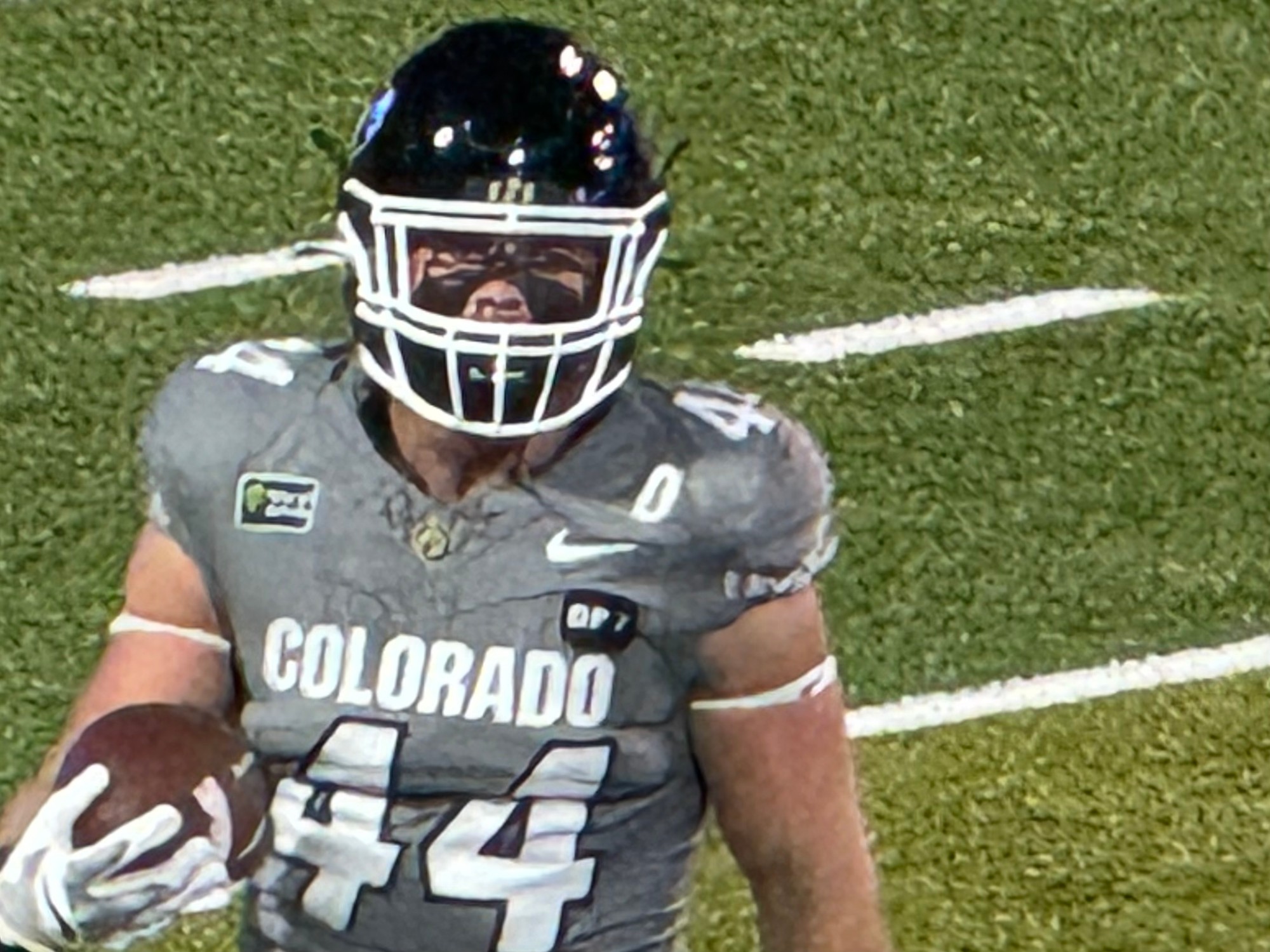
I barely remember hearing the band play the fight song on Saturday night.
I know Fernando Lovo has worked hard to improve the gameday experience. Part of that apparently involves more piped in music and the “band in the stands” and less of the CU marching band.
I miss the band. I miss hearing the fight song.
The CU marching band creates energy in the stadium and binds CU to its history (yes, Deion Sanders fans, CU has a pretty damn good football history).
It is a small thing. It is also precisely the kind of small thing that no one in the CU AD is paying attention to and that we can flag, which has been a theme of this blog. [Also, as an aside, the AD knocked it out of the park when it decided to air the day’s earlier games on the backside of the big scoreboard facing Colorado Blvd. Great move. I’m upset I didn’t think of that!]
One more thing — can we replace the giant ratty US flag crest that the band displays when playing America the Beautiful and the national anthem? It hasn’t been washed in 37 years. No other team uses a flag crest. It’s time to put it down.
Where this leaves us
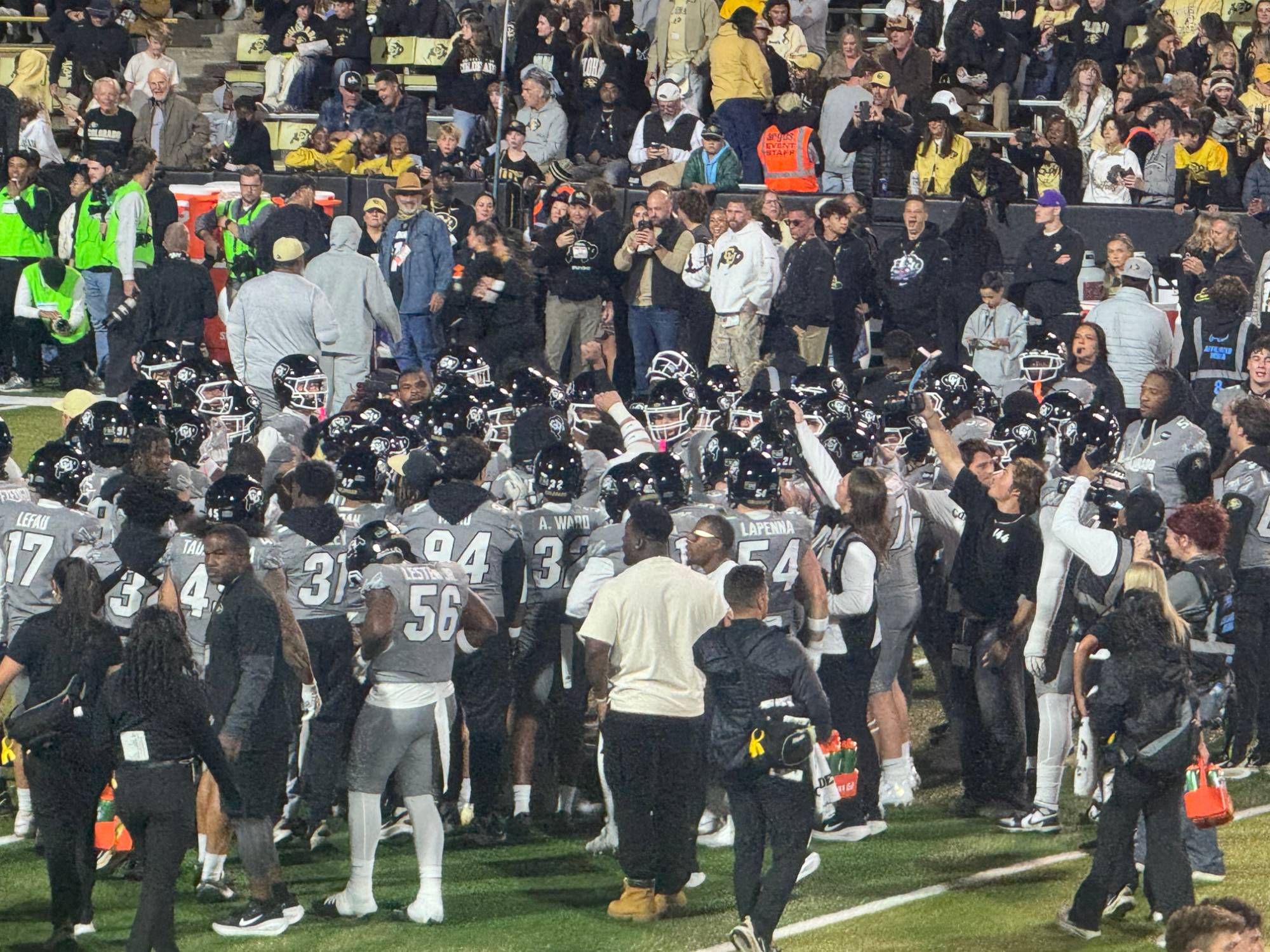
CU plays Oklahoma State in Stillwater on Saturday, and the Cowboys are ranked 18th nationally. Oklahoma State QB Drew Mestemaker is currently projected to be a top 5 pick in the NFL draft, so there’s another reason to watch.
Then Kansas State, Arizona State, Houston, Cincinnati and UCF. Three of those six are currently ranked. Bowl eligibility requires four wins from here.
I’d be surprised if CU won 3 more games this season.
What Saturday showed is that the gap between this team and a top-15 team is not just talent. It is also 93 yards of penalties.
This remains a coaching issue.
Sanders said he was proud of the team. He should be. They played hard enough to beat a 6-0 team.
Then they beat themselves, again, the way they have beaten themselves every week since September.
OTITAIBDEFTP (Other things I thought are interesting but don’t exactly fit this post)
Just two things, both from Twitter:
- This is still the best way to fix college football’s conference / playoff issue. Pat Forde originally came up with this, and I have no notes. https://x.com/tweetsofcat/status/2109659778486337631?s=12
- As a college sports bigamist (I’m a Michigan grad as well as CU grad), my ear is close to the ground in Ann Arbor. Bottom line here is that Dan Wetzel is 100% right. The 24-team playoff will bite the Big 10 and the SEC in the ass.
- Researchers at Colossal Biosciences have just announced that AI will hasten the return of the extinct dodo bird. https://www.reuters.com/science/us-company-announces-progress-toward-resurrecting-extinct-dodo-2026-10-14/
How to Watch CU Athletics This Week, Sponsored by SportsDeck
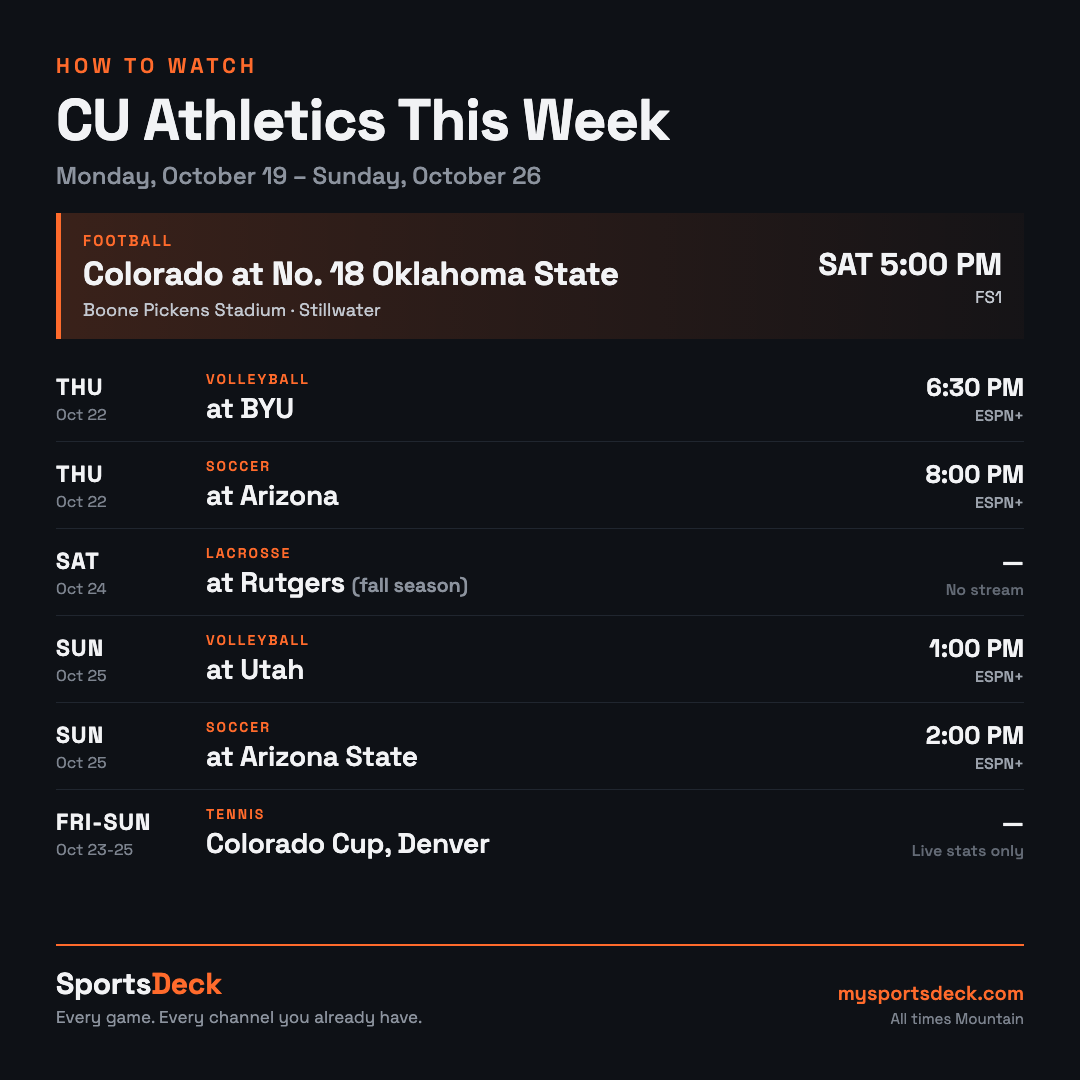
Football: Colorado at No. 18 Oklahoma State
Saturday, 5 p.m. Mountain on FS1
FS1 is on every cable and satellite package. Cord-cutters: YouTube TV, Hulu + Live TV, Fubo, DirecTV Stream and Sling Blue all carry FS1. Radio is KOA 850 AM and 94.1 FM.
Volleyball: at BYU, then at Utah
Thursday, 6:30 p.m. MT at BYU — ESPN+
Sunday, 1 p.m. MT at Utah — ESPN+
Two Big 12 road matches in four days. ESPN+ is the standalone streaming service, not the ESPN channel.
Soccer: at Arizona, then at Arizona State
Thursday, 8 p.m. MT at Arizona — ESPN+
Sunday, 2 p.m. MT at Arizona State — ESPN+
The Buffs close the regular season with a desert road swing. Both on ESPN+.
Also this week
- Tennis: Colorado Cup, Denver, Friday through Sunday
- Lacrosse: at Rutgers Saturday and at Columbia Sunday (fall season)
Neither is televised. Live stats and results are on CUBuffs.com.
“How to Watch” events, between a wp:separator above and the OTITWI heading below.
Each line is its own wp:paragraph. –>
This section is sponsored by SportsDeck, an app I built after getting tired of finding out my team had played yesterday, on a channel I already had.
Here’s how it works:
You tell it which teams you follow (there are 3,220 teams on SportsDeck across 47 sports leagues) and which streaming and TV services you already pay for. SportsDeck tells you every game your teams play, what time it starts, what channel or app it’s on, and whether you can actually watch it with what you’ve got. It can even show you whether there’s a cheaper way to watch more of your teams’ games.
Then it does the part I’m proudest of: it brings together your teams’ news, podcasts, YouTube videos, and trusted local coverage in one place—like the old sports page you miss, rebuilt for today’s world. SportsDeck has 454 of these pages, and I built and curate the whole operation.
You can also get a morning email with your games, viewing information, and biggest team stories before your coffee. There are game alerts and an iPhone widget, too.
Your first month of Pro is free. Get the iPhone app or start at mysportsdeck.com.
More BuffsBlog You Might Have Missed
Five Things I Think We Learned About CU After Texas Tech
Colorado led the No. 12 team in the country at halftime and scored seven points.
A Pessimist’s Preview of the CU Buffs
Eleven newcomers, a transfer class ranked 88th, and why I am not buying the hoops team either.
Ten Reasons CU Women’s Basketball Will Be Dancing in March
Chris Gaddis on why JR Payne’s Buffs, picked eighth, are better than that.
I noticed the same thing re: lack of fight song getting played at Folsom this season. I miss the F em up, F em up, go CU! cheer.
You mean “Buffaloes, Buffaloes, Go CU!”? 🙂
Interesting stuff. The fact that we’re giving back over 20% of your gained yards in penalties is pretty awful (and I’ve not seen that kind of analysis anywhere else). You’re the best.
And I appreciate the comments to the “Deion Sanders” fans that CU has a history that predates Prime Time.
I’m a lover, not a fighter. I welcome everyone to the CU sports table. But I agree that there are some newer CU fans that don’t appreciate / understand CU’s history, and it’s on them to learn that there’s more to CU football over the last 100+ years than Deion Sanders.
Another great article, John – thanks! A few thoughts:
– I don’t fault Wilson for the first INT. The WR let the defender pull it out of his hands. Yes, turnovers are still a problem and the second INT was a killer.
– We need to be careful with the statistics. The 10 penalties for 93 yards were not all on offense and subtracting the full amount from our offensive yardage or rush yardage is misleading. I would argue that extending the opponent’s drive can be as impactful as ending one of our drives.
– We have to add in the slow starts to the reasons we are losing. This is really the first game where halftime adjustments have shown up on the field.
– Not yours, but I mostly like the conference realignment chart, except it gives Penn St a free pass to the playoffs every year. It would require tv money realignment also or we might as well just skip ahead to a SEC/B1G league and an everybody else league.